
Why Your Hips and Thoracic Spine Are Key to a Healthy Throwing Arm
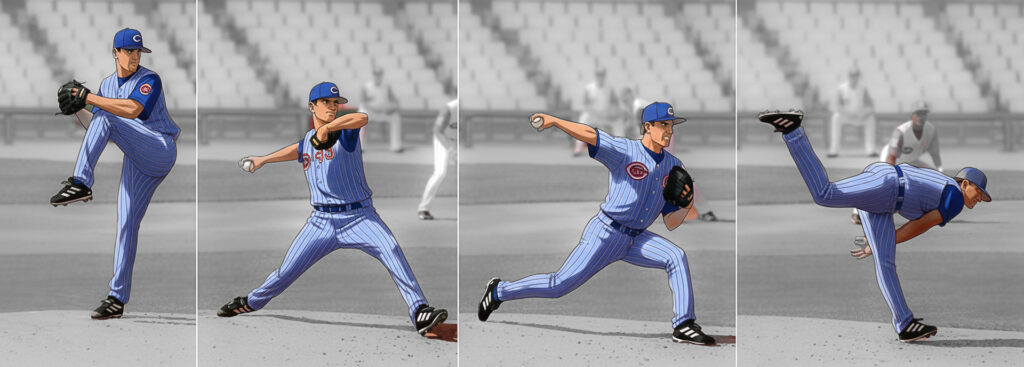
When you watch a pitcher deliver a fastball, it’s easy to focus on the arm action. But a great throw—whether it’s a baseball, softball, javelin, or football—starts way before the object leaves the hand. It begins in the feet, throughout the legs, into the hips and spine. Throwing isn’t just about arm strength and power; it’s about how your whole body works together like a well-oiled machine. If one part—like the hips or thoracic spine—isn’t doing its job, the shoulder and elbow may take on extra stress, which can lead to injury or a decrease in velocity.
As a physiotherapist with a background in baseball (both playing and coaching), personal training and strength coaching, and a passion for treating athletes, I’ve seen how critical the connection between the pelvis and thoracic spine is for keeping throwers healthy and performing at their best. Let’s break down why this relationship matters for all throwing athletes and how it can help you stay strong in your sport.
The Kinetic Chain: Your Body’s Power Highway
Picture your body as a chain where each link—your legs, hips, core, thoracic spine, and shoulder—passes energy to the next to create a powerful throw. This is called the kinetic chain.
For a throw to be efficient, every link needs to move at just the right time. The hips and shoulders must separate, beginning with hip rotation, sending energy up through the core and thoracic spine (the part of your spine behind your ribcage), and finally to the shoulder and arm.
If the timing between the pelvis and thoracic spine is off, the energy transfer gets affected. Too much lag between these movements—or not enough—means the shoulder has to work harder, which can decrease throwing velocity or distance and increase the risk of injury.
Timing Troubles: Technique or Mobility?
When a thrower’s hips and thoracic spine aren’t moving in sync, coaches and clinicians should be asking: Is this a technique issue, or is the athlete’s mobility impairing the ability to move into more optimal positions? Both can cause problems.
For example, if the hips don’t rotate fully because of limited mobility, the energy doesn’t flow smoothly up the chain. Limited motion in the lower body forces the shoulder and elbow to pick up the slack, which can lead to strain or injury.
Similarly, if the thoracic spine lacks motion and can’t rotate or extend properly, the shoulder blade (scapula) can’t move freely, which limits the movement quality and puts extra stress on the shoulder.
Hips: The Power Base
Your legs are the engine of a throw. If they’re not strong or mobile, the whole system suffers. Research shows that weak hip muscles or limited hip mobility can negatively impact throwing performance.
For instance, landing with your lead foot too “open” (pointing outward) can disrupt how energy moves from your legs to your upper body, putting more force on the front of your shoulder and inside of your elbow. Strong hip muscles—like the hip abductors (which move your leg sideways) and external rotators (which help rotate your leg outward)—are critical for keeping your pelvis stable and powerful.
As a NSCA certified strength and conditioning coach and a FRC mobility specialist, I emphasize exercises like side lunges and multi directional lunge variations (curtsy lunges, landmine lunges, hatfield split squats) to keep your hips strong and mobile. Prioritize legs in your lifting schedule as power comes from the ground up—strengthening your entire hip can improve both your velocity and efficiency of movement, whether you’re on the baseball diamond or the football field.
Thoracic Spine: The Shoulder’s Support System
The thoracic spine, the part of your spine that supports your ribcage, is another key player. It needs to be mobile enough to rotate and extend (think arching backward slightly) to support the shoulder blade and arm during a throw.
If your thoracic spine is stiff, it can lead to a slouched posture, which limits how well your shoulder blade moves. This forces your shoulder and elbow to work overtime, increasing the risk of injury and reducing your throwing power.
Keeping your thoracic spine flexible and strong helps your shoulder blade glide smoothly, giving your arm the freedom to perform at its best. As a former hockey and baseball player from Saskatchewan, I know how important it is to keep this area mobile through stretches like thoracic rotations or foam rolling.
Putting It All Together
Throwing at high speed is like conducting an orchestra—every part of your body has to play its part in perfect harmony. If your hips or thoracic spine aren’t pulling their weight, your shoulder and elbow end up overworked, which can hurt both your performance and your health.
My rehab philosophy—“Build confident people. Create better movers.”—focuses on reverse-engineering your movement needs to unlock your full potential, whether you’re new to exercise or chasing the next level in your sports development for a competitive edge.
HIP DRILLS
To stay at the top of your game, focus intensely on hip strength, power, and mobility. Work on exercises like side lunges, deadlifts, Copenhagan planks, and loaded pigeon stretches to ensure your hips remain both strong and mobile, which is crucial for efficient energy transfer in the kinetic chain.
THORACIC SPINE DRILLS
Thoracic spine in flexion extension and rotation strength, power, and mobility as well as rib mobility: Try mobility exercises like flat bench thoracic extensions, cat/cow variations with thoracic focus, breath work focused on rib expansion to facilitate more thoracic motion.
CORE DRILLS
A strong core connects your hips and upper body, helping energy transfer smoothly during a throw in addition to resisting unwanted motion.
Proper technique: Be a student of your sport and work on your mechanics in the gym and your position. Before chasing velocity or big weights, chase great movement.
By keeping your hips and thoracic spine in top shape, you’re not just protecting your shoulder—you’re setting yourself up to throw harder, faster, and longer.
With my background in treating athletes and tactical athletes (firefighters, police, and military), I’ve seen how these principles help throwers across sports reach their goals and aspirations, both on and off the field.
About the Author: Nolan Berner is a musculoskeletal physiotherapist with a Doctor of Physiotherapy degree from Australia.
He completed his clinical internship at Stanford University with NCAA athletes and holds a Bachelor’s degree in Sport, Exercise & Wellness. He is a certified strength and conditioning coach (NSCA), a Functional Range Conditioning mobility specialist, and a Functional Range Assessment specialist.
Nolan has published research on the impact of load placement variations on police officers with the Tactical Research Unit. He is a former junior hockey player and AAA baseball player from Saskatchewan, he brings his athletic experience and passion for treating athletes to his work, helping everyone from weekend warriors to professionals unlock their movement potential.
References
Kline, D., Fischer, S. K., Bullock, G. S., Kissenberth, M. J., Shanley, E., & Thigpen, C. A. (2025). Risk Factors and Injury Prevention in the Throwing Athlete. ScienceDirect, 7(2). https://doi.org/10.1016/j.asmr.2024.101037
Diffendaffer, A. Z., Bagwell, M. S., Fleisig, G. S., Yanagita, Y., Stewart, M., Cain, E. L., Jr., Dugas, J. R., & Wilk, K. E. (2023). The Clinician’s Guide to Baseball Pitching Biomechanics. Sports health, 15(2), 274–281. https://doi.org/10.1177/19417381221078537
Fortenbaugh, D., Fleisig, G. S., & Andrews, J. R. (2009). Baseball pitching biomechanics in relation to injury risk and performance. Sports health, 1(4), 314–320. https://doi.org/10.1177/1941738109338546
Matsuo, T., Escamilla, R. F., Fleisig, G. S., Barrentine, S. W., & Andrews, J. R. (2001). Comparison of Kinematic and Temporal Parameters between Different Pitch Velocity Groups. Journal of Applied Biomechanics, 17(1), 1-13.
Stodden, D. F., Fleisig, G. S., McLean, S. P., & Andrews, J. R. (2005). Relationship of biomechanical factors to baseball pitching velocity: within pitcher variation. Journal of Applied Biomechanics, 21(1), 44–56. https://doi.org/10.1123/jab.21.1.44